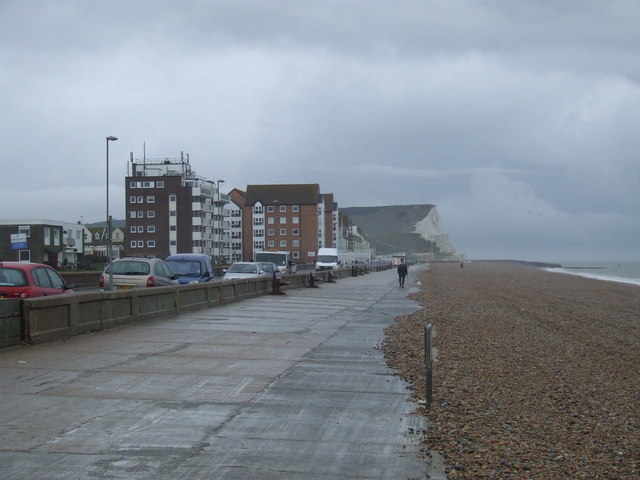
Seaford's Victorian Heyday: How the Railway Tried to Build a Second Brighton
When the railway arrived on 1 June 1864, Seaford set out to reinvent itself as a fashionable seaside resort. Hotels rose along the seafront, bathing machines lined the shingle, terraces in Brighton style climbed the slope behind the Esplanade, and even Edward VII came to stay. But the South Coast had other plans.
For most of its long history, Seaford had turned its back on the sea. The Cinque Port had silted up, the harbour had been stolen by Newhaven in 1539, and the town had spent the next three centuries as a quiet farming parish, raided occasionally by smugglers and battered regularly by the gales coming up Seaford Bay. Then, on 1 June 1864, the London, Brighton and South Coast Railway opened its branch line down from Lewes, and the town tried to reinvent itself as a Victorian seaside resort.
The Train That Changed Everything
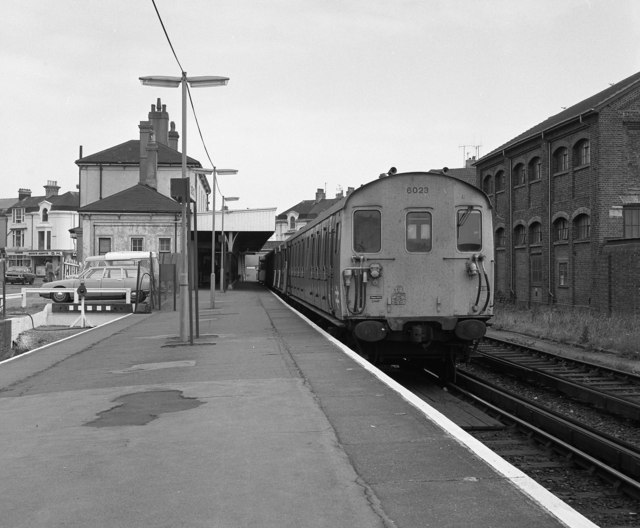
The new station was a building of painted stucco and slate roof, finished in 1860 in anticipation of a line that took another four years to arrive. It was designed as a through station rather than a terminus, the LBSCR planned to push on to Eastbourne, and the platforms were laid out to feed traffic onward. That extension never came; Seaford has been the end of the line ever since.
But for a town that had taken the better part of a day to reach by horse-drawn coach, the railway was transformational. London was suddenly four hours away. The White Lion on the High Street, an old coaching inn whose business the train had just killed overnight, reinvented itself as a hotel for the new seaside visitors. Up at the station, day-trippers piled into open landaus for the short ride down to the seafront.
Bathing Machines and the New Esplanade
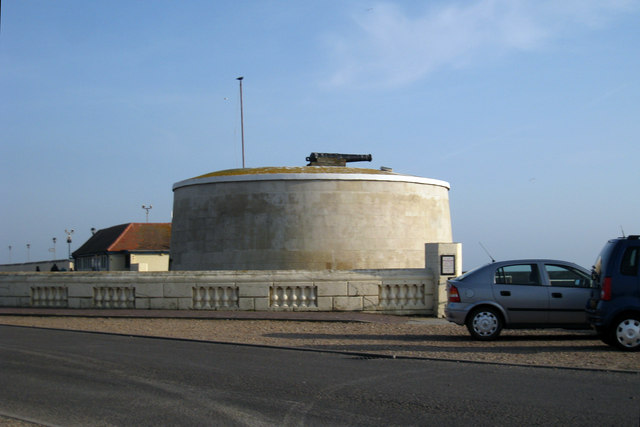
The shingle between the Martello Tower and Dane Road soon filled up with bathing machines, wooden huts on cartwheels that visitors changed inside while horses (and later a steam-driven winch) pulled them out into the shallows so that ladies could slip into the water unobserved. An Edwardian guidebook praised the local fleet as being "of the most improved style," and noted that boats could be hired by the hour and yacht trips taken across the bay. One of those bathing machines survives, restored, inside the Martello Tower museum.
The seafront itself had been levelled and raised. Pelham Road and Marine Parade were laid out, the elevated promenade was built up from the Steyne to the shore, and the first terraces were thrown up facing the Channel. Marine Terrace, a row of four houses dating from around 1840 and given Brighton-style verandas, predated the railway; everything else came afterwards. Pelham Road in particular was developed from 1857 onwards by the Seaford Improvement Committee, an early attempt to professionalise the town's seaside ambitions.
The Esplanade Hotel, and a King's Visit
The flagship of the whole enterprise was the Esplanade Hotel, opened in 1891 between the Martello Tower and Dane Road. It was an exuberant pile, "a very handsome and ornate building" of more than fifty rooms, "furnished in recherche style" and explicitly designed to compete with the grand hotels of Brighton and Eastbourne. There were less prestigious rivals further inland, the Bay Hotel on Pelham Road and the Wellington Hotel on Steyne Road, the latter a rebranding of the old New Inn, but the Esplanade was the address.
In 1905, King Edward VII stayed at the Esplanade Hotel, an event the town never quite stopped talking about. For a brief moment, Seaford had the cachet its promoters had been chasing for forty years.
A Second Brighton That Never Was
Behind the seafront, the Seaford Bay Estate Company had drawn up a plan that would have made the town unrecognisable. The intention was twelve parallel roads of terraced housing running back from the Esplanade to College Road and Steyne Road, with a miniature Royal Crescent at the centre, near the Martello Tower. It was, as one contemporary put it, an attempt to "imitate Brighton."
What the company had not allowed for were Seaford's winter gales. Storms in 1824 and 1875 had already smashed the seafront defences and flooded the lower town; the new terraces, when they were finished, proved a punishing place to live in January. Many of the early seaside houses were never sold. The grand crescent was never built. By the turn of the century, the town had quietly rebranded itself again, first as a place for convalescent homes (a string of them built between 1870 and 1901, drawn by the bracing air) and then, from around 1903, as a town of private boarding schools, of which there were eventually more than twenty. The schools, not the seaside, would become Seaford's defining trade until the Second World War.
What Survives
Walk the seafront today and the Victorian heyday is everywhere if you know where to look: the long sweep of Marine Parade, the elevated promenade, the railway station with its 1860 stucco still intact, the Wellington pub on Steyne Road, the bathing machine inside the Martello Tower. The Esplanade Hotel itself is gone, demolished in the 1970s, after about eighty years of trade, but the wide flat terrace where it stood is still where Seaford goes to look at the sea.
The town never became a second Brighton. Looking at the price of property in Brighton, that is probably no bad thing.
Sources
- History of Seaford, Seaford Museum & Heritage Society
- Seaford railway station, Wikipedia)
- Seaford Railway Station, Historic England List Entry 1044019
- Martello Tower No. 74, Seaford, Historic England List Entry 1017359
- Marine Terrace, Seaford Heritage Walks
- Pelham Road, Seaford Currents
- QR Stories, Seaford Museum
- Local archive notes on the Esplanade Hotel, Bay Hotel and Wellington Hotel held in the project archive at `Thoughts-Ideas-Expansion/archives/seaford-sussex-co-uk.md`